
Diversity in the Living World
Learning Objectives
- Appreciate the extraordinary range of habitats and organisms on Earth
- Define biodiversity and understand how species are discovered
- Explain why local names create confusion and why nomenclature is needed
- Distinguish between identification and nomenclature
- Know the contributions of Ernst Mayr to biology
Diversity in the Living World
The living world is full of surprises. Organisms thrive in places you would least expect: on frozen mountain peaks, in scorching deserts, at the bottom of oceans, inside boiling hot springs, across deciduous forests (where trees shed leaves seasonally), and in calm freshwater lakes. A galloping horse, a flock of migrating birds, a valley carpeted with wildflowers, a shark slicing through water: each scene showcases a different facet of life’s remarkable range.
What Makes Us Ask “What Is Life?”
This diversity runs deeper than what meets the eye. Within a population (a group of organisms of the same species living in one area), individuals compete for resources and cooperate for survival. Between different populations in a community (multiple species sharing the same habitat), there are intricate webs of predation, symbiosis, and competition. Go even deeper, and inside every single cell, millions of molecules are in constant motion, carrying out the chemical work that keeps the organism alive.
All of this stirs a profound question: what indeed is life?
That question actually contains two separate puzzles:
- The technical question — what separates something that is alive from something that is not?
- The philosophical question — what is the purpose of life?
Science takes on the first puzzle. The second lies outside its reach.
How Vast Is This Diversity?
Step outside and you will spot potted plants, insects, birds, pets, and a variety of other organisms. But beyond what your eyes can catch, there are countless organisms invisible to the naked eye — bacteria, fungi, protists — living all around you.
Expand the area you observe and the count climbs steeply. A dense forest, for instance, hosts a far greater number and variety of organisms than a garden or a street. How do biologists make sense of all this variety? They start by recognising that each distinct type of organism qualifies as a species (the basic unit used to tell one kind of life from another). So far, roughly 1.7 to 1.8 million species have been formally catalogued. That staggering tally is what scientists call biodiversity (the full sweep of living types found on the planet).
Yet even that number captures only a fraction of the real total. Researchers keep finding new organisms in places already studied, which means the catalogue of life is still growing.
Why Do Organisms Need Standardised Names?
Ask ten people in ten different regions what they call a particular plant and you may get ten different answers. These local names serve daily conversation well enough, but they fall apart the moment two scientists from different parts of the country try to compare notes. The same organism can carry completely unrelated names just a few districts apart.
Biologists tackled this communication problem by creating nomenclature (a worldwide system that assigns one fixed scientific name to every known organism). Before any name can be given, though, the organism needs to be precisely described so that everyone agrees on exactly which living thing the name refers to. That prerequisite step is called identification (the careful description and recognition of an organism). Without solid identification first, naming becomes meaningless.
Ernst Mayr (1904-2004) — The Darwin of the 20th Century
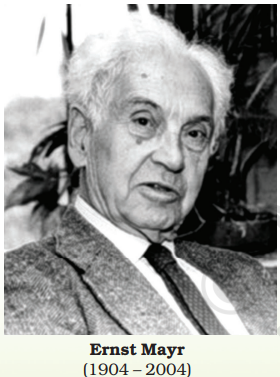
Few scientists have shaped our understanding of life’s diversity as profoundly as Ernst Mayr. Born on 5 July 1904 in Kempten, Germany, Mayr went on to become one of the most celebrated evolutionary biologists in history, widely regarded as one of the 100 greatest scientists of all time.
Mayr spent much of his career at Harvard University, joining the Faculty of Arts and Sciences in 1953 and retiring in 1975 with the title Alexander Agassiz Professor of Zoology Emeritus. Across a career spanning nearly 80 years, his work touched an extraordinary range of fields: ornithology (study of birds), taxonomy (science of classification), zoogeography (geographical distribution of animals), evolution, systematics (study of evolutionary relationships), and the history and philosophy of biology.
His most lasting impact was framing the origin of species diversity as the central question of evolutionary biology. Before Mayr, the field lacked a clear focal point; after him, it revolved around understanding how and why new species arise. He also pioneered the currently accepted definition of a biological species, giving biologists a precise way to draw boundaries between one species and another.
Mayr received three awards collectively known as the triple crown of biology:
- Balzan Prize — 1983
- International Prize for Biology — 1994
- Crafoord Prize — 1999
He lived to the age of 100, passing away in 2004.