
The Top of the Ladder — Phylum, Kingdom and the Complete Hierarchy
Learning Objectives
- Define phylum and its plant equivalent (division)
- Understand kingdom as the highest and broadest taxonomic category
- Trace the complete taxonomic hierarchy from species to kingdom
- Apply the hierarchy to real organisms using Table 1.1
The Top of the Ladder — Phylum, Kingdom and the Complete Hierarchy
We have climbed through species, genus, family, order, and class. Two ranks remain at the very top of the ladder: phylum (or division for plants) and kingdom. Once we understand these, the entire classification structure falls into place.
Phylum — A Shared Body Plan
Phylum is the rank that groups together related classes. At this level, the feature that ties members together is usually a fundamental body plan — a deep structural blueprint shared by all organisms in the group, even if they look very different on the surface.
Consider how diverse fishes, frogs, lizards, eagles, and whales are. Yet all of them share two features at some point during their development:
- A notochord (a flexible, rod-shaped support structure running along the back)
- A dorsal hollow neural system (a hollow nerve cord along the back, which typically develops into the spinal cord and brain)
These two shared features place all of them in the phylum Chordata. A fish and an eagle look nothing alike, yet the same deep architecture connects them.
Division — The Plant Equivalent
Plants do not use the term “phylum.” Instead, classes of plants with a few shared features are grouped into a Division. For example, Angiospermae (flowering plants that produce seeds enclosed within a fruit) is a division that contains both monocots and dicots.
Kingdom — The Broadest Category
At the very top of the hierarchy sits the Kingdom, the widest grouping of all:
- Kingdom Animalia — encompasses every animal from every phylum, from jellyfish to humans
- Kingdom Plantae — encompasses every plant from every division, from mosses to towering trees
These two are commonly referred to simply as the animal kingdom and the plant kingdom.
The Full Hierarchy at a Glance
Arranged from the most specific to the most broad, the seven standard ranks are:
Species → Genus → Family → Order → Class → Phylum/Division → Kingdom
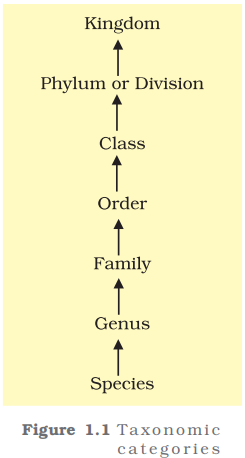
These seven represent the major categories. In practice, taxonomists have also introduced sub-categories (sub-phylum, sub-class, sub-order, and so on) to allow finer, more accurate placement of organisms that do not fit neatly into the main ranks.
Three Principles That Govern the Hierarchy
Understanding why the hierarchy works the way it does comes down to three rules:
- Shared characters decrease as you go up — members of the same species have a great deal in common; members of the same kingdom may share only a few very basic features
- Lower taxa have tighter bonds — the lower the rank, the more features its members share with one another, making the group more cohesive
- Higher ranks are harder to compare — at the top of the hierarchy, working out how one phylum relates to another phylum (or one division to another division) is far more complex than comparing two species within a single genus
The upshot is that classification becomes progressively more challenging at higher levels, which is exactly why sub-categories and additional evidence (like molecular data) become important.
Putting It All Together — Four Organisms, One Hierarchy
The table below traces four familiar organisms through every rank, from genus to phylum or division. Notice how organisms that look nothing alike can still share higher-level categories, while organisms from the same division can differ sharply at the class level.
| Rank | Man | Housefly | Mango | Wheat |
|---|---|---|---|---|
| Biological Name | Homo sapiens | Musca domestica | Mangifera indica | Triticum aestivum |
| Genus | Homo | Musca | Mangifera | Triticum |
| Family | Hominidae | Muscidae | Anacardiaceae | Poaceae |
| Order | Primata | Diptera | Sapindales | Poales |
| Class | Mammalia | Insecta | Dicotyledonae | Monocotyledonae |
| Phylum/Division | Chordata | Arthropoda | Angiospermae | Angiospermae |
What the Table Reveals
- Hominidae — the family of great apes, including humans
- Muscidae — the family of houseflies and related species
- Anacardiaceae — the cashew and mango family
- Poaceae — the grass family, covering wheat, rice, maize, and other cereals
- Diptera — the order of two-winged insects (flies and mosquitoes)
- Insecta — the class of insects, characterised by six legs and a three-part body
- Arthropoda — the phylum of animals with jointed legs and an external skeleton (insects, spiders, crabs)
- Dicotyledonae — a class of flowering plants whose seeds have two seed leaves (cotyledons), like mango
- Monocotyledonae — a class of flowering plants whose seeds have one seed leaf, like wheat and rice
- Angiospermae — the division of flowering plants that produce seeds inside a fruit
Key Observations
Mango and wheat both belong to the same division (Angiospermae) because both are flowering plants. Yet they part ways at the class level: mango is a dicot (two seed leaves) and wheat is a monocot (one seed leaf). This shows how organisms can be alike at a broad level but differ sharply when you zoom in.
Man and housefly are both animals, but they belong to entirely different phyla — Chordata and Arthropoda respectively. Their body plans are so different (internal skeleton versus external skeleton, spinal cord versus ventral nerve cord) that they diverge at one of the highest ranks. This illustrates how the same kingdom can contain organisms with vastly different architectures.
These examples bring home the core principle of the hierarchy: the higher the shared rank, the fewer features organisms have in common; the lower the shared rank, the more closely related they are.